

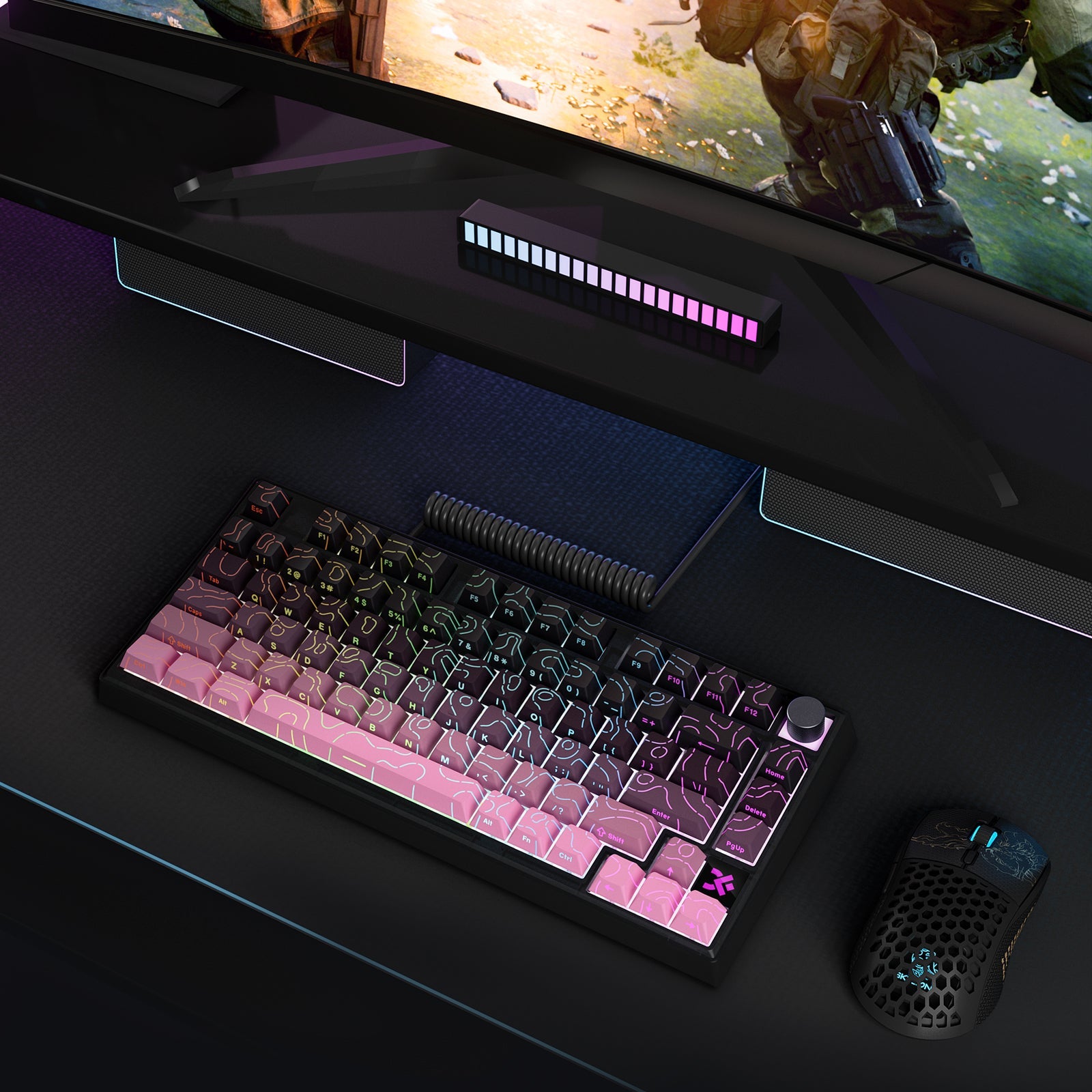
What Is SOCD on a Keyboard? Snap Tap and Null Bind Explained
If you play competitive FPS games, you have probably run into the term SOCD alongside names like Snap Tap, null bind, and rapid trigger. It is one of the most argued-about topics in the gaming keyboard world right now, and also one of the most misunderstood. Is SOCD a feature, a setting, or a form of cheating? Does every magnetic keyboard have it? Will it get you kicked from a match? This guide breaks down what SOCD on a keyboard actually means, how SOCD resolution works, how it differs from rapid trigger, and where the competitive rules currently stand.
What Does SOCD Stand For?
SOCD stands for Simultaneous Opposite Cardinal Direction. It describes what happens when you hold two opposing directional inputs at the same time, most commonly the A and D keys for strafing left and right, or W and S for forward and back.
A normal keyboard has no opinion about this situation. It reports both keys as held, and the game decides what to do, which in most shooters means you stop moving or keep moving in the direction you pressed first. SOCD handling is the logic that resolves that conflict on purpose instead of leaving it to chance. The term comes from the fighting game community, where leverless arcade controllers had to define what happens when a player holds left and right together, long before the idea reached mechanical keyboards.
How SOCD Resolution Works
There are a few common ways a keyboard or controller can resolve opposing inputs. The specific behavior is usually called the SOCD resolution mode or SOCD cleaning method:
- Last input priority — the most recently pressed key wins and the older key is temporarily ignored. This is the mode marketed as Snap Tap and the one that matters for FPS movement.
- Neutral resolution — pressing both opposing keys cancels both, so the character stops. This is the standard requirement in much of the fighting game scene.
- First input priority — the key you pressed first keeps control until you release it, and the second press does nothing.
A null bind is the software equivalent of the same idea. Instead of the keyboard resolving the conflict in firmware, an in-game script or config binds the keys so that pressing one automatically releases the other. The end result looks similar to the game, which is exactly why anti-cheat systems treat the two together.
Why SOCD Matters in FPS Games: Counter-Strafing Explained
In tactical shooters, your bullets are only accurate when your character is standing still. Because movement has momentum, letting go of a strafe key is not enough to stop instantly. Skilled players use counter-strafing: they tap the opposite direction key for a fraction of a second to kill that momentum, then shoot.
Done by hand, counter-strafing is a real skill with a real failure rate. Release too late and you are still sliding. Hold too long and you start moving the other way. SOCD with last input priority removes that timing window entirely. Every direction change becomes a clean, instant stop, so the player gets maximum accuracy on every peek and every strafe swap without ever mistiming the input.
That is the whole controversy in one sentence: the feature does not aim for you, but it does perform a timing-based mechanical skill on your behalf.
SOCD vs Rapid Trigger: What Is the Difference?
These two features get mixed up constantly because they often appear on the same Hall effect keyboard spec sheet, but they solve completely different problems.
- Rapid trigger changes when a single key resets. Instead of a fixed reset point, the key reactivates as soon as you reverse direction by a tiny amount, so repeated presses register faster. It affects one key at a time.
- SOCD changes how two opposing keys interact. It does not make any single key faster; it decides which of two conflicting inputs the game hears.
You can have one without the other. Rapid trigger depends on analog travel sensing, which is why it lives on magnetic and Hall effect switches, while SOCD logic can in principle run on any keyboard with programmable firmware. In practice they are bundled together on gaming boards because both target the same competitive audience. If you want the full background on the analog side, our guides on rapid trigger and adjustable actuation cover how magnetic sensing works in detail.
Is SOCD or Snap Tap Banned?
This is the part people most need to get right, because the answer is not the same everywhere.
The most decisive ruling came from Valve. In an update on August 19, 2024, Counter-Strike 2 began detecting what Valve described as movement and shooting input automation, specifically naming hardware-assisted counter-strafing, with detection on official servers resulting in a kick from the match. The same update also caused input binds containing multiple commands to be ignored by default, which swept up scripted null binds and jump binds at the same time. That policy has remained in place since.
Outside of Valve's own servers the picture is less uniform. Third-party platforms, leagues, and tournament organizers set their own rules, and they have not all reached the same conclusion. Other competitive titles have taken different positions, and some have never published a clear hardware policy at all, which leaves players in a gray area rather than a green light.
The practical takeaway for anyone shopping for a gaming keyboard with SOCD:
- Check the current ruleset for the specific game and platform you play on, since these policies have changed before and can change again
- Understand that "not detected" is not the same as "allowed"
- Remember that a ruleset for casual play may differ from the one used in ranked, league, or LAN competition
- Note that in the fighting game community, SOCD resolution is not banned at all but standardized, with tournaments specifying which resolution mode is legal
Meanwhile, rapid trigger and adjustable actuation have not been swept up in the same bans. They alter how a single key behaves rather than automating a two-key sequence, which is why magnetic keyboards remain fully usable in competitive play even where SOCD is prohibited.
SOCD, Hall Effect Switches, and Magnetic Keyboards
Because Snap Tap arrived on high-end gaming boards at the same moment Hall effect keyboards went mainstream, many people assume the two are the same technology. They are not. A Hall effect switch uses a magnet and a sensor to measure exactly how far a key has traveled, which unlocks adjustable actuation points, rapid trigger, and analog input. SOCD is a firmware decision layered on top, and whether a board exposes it depends entirely on that manufacturer's configuration software.
If you are building around magnetic sensing, the Skyloong GK68HE Magnetic Keyboard is a 67-key aluminum board with an 8000Hz polling rate, 0.125ms latency, 0.01mm rapid trigger, and actuation adjustable from 0.1mm to 4mm, plus 4-in-1 dynamic keystroke actions and hot-swap support for Skyloong, Gateron Jade Pro, and TTC Maneto magnetic switches. The Skyloong HE75 Magnetic Keyboard offers the same 8000Hz polling and 0.01mm zero-dead-zone rapid trigger with adjustable actuation from 0.1mm to 4.0mm and N-key rollover. For a board that runs magnetic and traditional mechanical switches side by side, the Skyloong GK68HEAT Mix Keyboard pairs a hybrid switch system with tri-mode connectivity and a gasket-mounted aluminum case.
You can browse the full range of magnetic keyboards and magnetic switches if you want to compare analog options directly. Because SOCD support varies by firmware and can be changed by a manufacturer update, always confirm the current feature list for the exact model before buying if that specific setting is your deciding factor.
Should You Use SOCD?
If you play on servers or in leagues where it is prohibited, the answer is simple: do not enable it. Getting kicked mid-match is a worse outcome than an imperfect counter-strafe.
If you play somewhere it is permitted, it is worth being honest about the trade. SOCD removes a timing skill rather than sharpening one, so muscle memory built on it does not transfer to a machine or a ruleset without it. Plenty of strong players deliberately leave it off for that reason. Features like rapid trigger, a high polling rate, and a well-chosen actuation point deliver a real responsiveness gain without sitting anywhere near a rulebook, which is why they are the safer place to spend your upgrade budget.
Frequently Asked Questions About SOCD Keyboards
What does SOCD mean on a keyboard?
SOCD stands for Simultaneous Opposite Cardinal Direction. It refers to how a keyboard resolves two opposing directional keys held at once, such as A and D, instead of letting the game decide.
Is SOCD the same as Snap Tap?
Snap Tap is a brand name for one specific SOCD resolution mode, last input priority, where the most recently pressed key overrides the one already held. All Snap Tap is SOCD handling, but not all SOCD handling behaves like Snap Tap.
Is SOCD banned in Counter-Strike 2?
Yes. Valve's August 19, 2024 update began detecting hardware-assisted counter-strafing and similar input automation on official servers, with a kick from the match as the result. Rules on third-party platforms and in other games vary, so check the ruleset where you actually play.
Do all Hall effect keyboards have SOCD?
No. Hall effect and magnetic switches enable analog features like rapid trigger and adjustable actuation, but SOCD is a separate firmware feature. Whether it is available depends on the specific keyboard and its configuration software.
Is rapid trigger banned along with SOCD?
No. Rapid trigger changes when a single key resets rather than automating a two-key sequence, and it has not been included in the input automation bans that affected SOCD and null binds.
Final Thoughts
SOCD on a keyboard is not magic and it is not aimbot. It is a firmware rule for resolving two opposing keys, packaged under names like Snap Tap and closely related to the older null bind scripts. Its competitive status is genuinely split: banned on Counter-Strike 2 official servers since August 2024, standardized rather than forbidden in fighting games, and unsettled in several other titles. If you are shopping for a magnetic gaming keyboard, focus first on the features that are universally allowed and measurably useful, including rapid trigger, adjustable actuation points, high polling rates, and solid build quality. Explore the full lineup of Hall effect and magnetic keyboards, mechanical keyboards, and key switches at GlacierPCGaming.com.


