

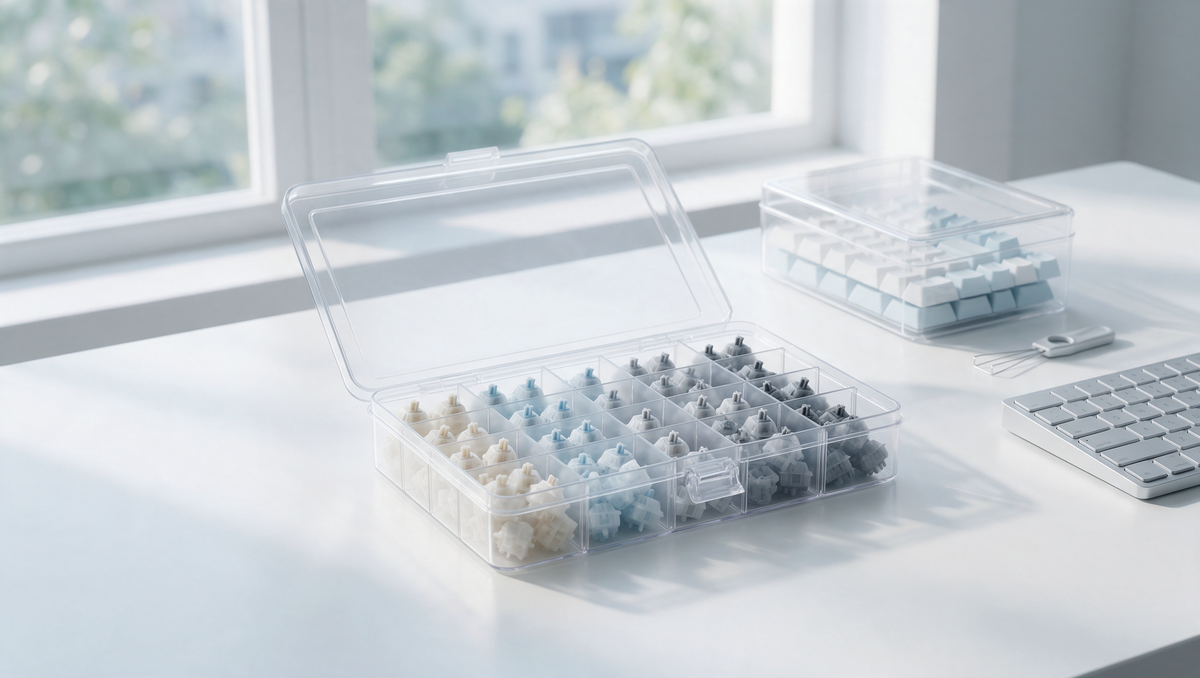
How to Store Mechanical Keyboard Switches and Keycaps Long-Term
If you have built more than one keyboard, you already have the problem. Loose switches in a sandwich bag. A half-used pack of linears in a drawer. Keycap sets stacked somewhere that is definitely not ideal. Mechanical keyboard switch storage is the least glamorous part of the hobby and the part that quietly costs people the most money.
This guide covers how to store mechanical keyboard switches and keycaps properly: what actually damages them over time, what does not, how to choose a switch storage container, and how to store lubed and magnetic switches without undoing your own work.
Why Proper Keyboard Switch Storage Matters
A single switch is cheap; a collection is not. Once you have sampled a few dozen linears, tactiles, and silents and hand-lubed a batch for a build, there is a real investment sitting in that drawer. Bad storage costs you three ways:
- Physical damage — bent pins and cracked housings from switches rattling loose against each other
- Contamination — dust, hair, and pocket lint working into the housing and ruining the feel and sound
- Lost time — not knowing which unlabelled bag holds which switch, so you buy them again
The third is the most common: most people do not ruin their switches, they just lose track of them.
What Actually Damages Switches in Storage
Dust is the real enemy. An MX-style housing is not sealed. Fine dust settles into the stem rails and around the leaf, and you feel it as scratchiness the first time you press the key. Switches left in an open jar or a torn bag for a year will not feel the way they did new.
Bent pins come from loose storage. Switches shifting against each other in a bag catch their metal contact legs on neighbouring housings. A bent pin is usually fixable with tweezers, but it is far easier to stop switches sliding around in the first place.
Humidity is a slow background risk. Most switch springs are steel, and plating helps, but a genuinely damp environment — a garage, a basement, an unheated storage unit — is not where a switch collection belongs. A closed container in a normal room is fine.
Static and heat are not real risks. A mechanical switch is a passive component with no semiconductors and nothing to zap, so anti-static bags are unnecessary. Keep switches out of direct sunlight and away from a radiator and you have covered the rest — the housings care far more about UV than about room temperature.
Choosing a Switch Storage Container
A good switch storage box does three jobs: it keeps dust out, stops switches sliding around, and lets you see what is inside without opening it. What to look for:
- A clear housing. Transparent polycarbonate means you identify a container by looking at it, not by opening six of them.
- Individual slots rather than one open cavity. Slotted trays hold each switch upright and separate, which is what actually prevents bent pins.
- A lid that closes firmly. The point is keeping dust out, so a loose-fitting lid defeats the purpose.
- Stackability. Collections grow, and containers that stack or interlock scale with you. A pile of mismatched tins does not.
The Kailh Switches Storage covers most of that list — transparent PC material so the contents are visible at a glance, room for up to 60 switches, and a cover and base that assemble in different configurations. See the rest of the options in the switches storage collection.
How to Organize a Switch Collection So You Can Find Things
Storage and organization are different problems. A sealed container solves storage; finding the right switch in thirty seconds is organization, and it needs a system. Three approaches work, and you can mix them:
- By switch type. One container for linears, one for tactiles, one for clickies, one for silents. The simplest system and the one most people should start with, because it matches how you think when picking switches for a build.
- By spring weight. Once you own several similar linears, type stops being a useful divider and force does.
- By build. Storing spares per keyboard means a dead switch is a two-minute fix rather than an archaeology project.
Label everything, immediately. This is the single highest-value habit in the hobby. A switch you can identify by sight today is an anonymous clear-housing linear in eight months. Write down the switch name and, if you lubed them, what you used and when. Keyboard forum regulars nearly all reach the same conclusion after losing a collection once: the label is worth more than the container.
Keep a few spares of each switch you run daily. A dead key on a hot-swap board is trivial to fix if you have one matching switch on hand — the key switches collection is the place to top those up.
Storing Lubed Switches Without Ruining the Lube
Hand-lubing a set is hours of work, so it is worth knowing what storage does to it. The good news: the greases most people use will not dry out. The PFPE-based greases that most switch lubricants are built on are non-volatile — they do not evaporate the way a solvent-carried lubricant does. A switch you lubed two years ago has not gone dry sitting in a box.
What does happen is migration. A thin film of grease on a stem rail slowly creeps along the surfaces it touches. In practice that means two rules:
- Store lubed switches upright in individual slots, not tipped over and touching each other in a pile
- Never store lubed and unlubed switches loose in the same bag, or you end up with a set that is accidentally and inconsistently lubed
Keep lubed switches in their own labelled container with the date and lubricant noted. If a set ever feels different from how you remember it, that note tells you whether the switch changed or you did.
How to Store Magnetic and Hall Effect Switches
Magnetic switches need one extra consideration, and it is not the one people expect. In a Hall effect keyboard the magnet sits in the stem and the sensor lives on the PCB, so a loose magnetic switch is just a small permanent magnet in a plastic housing.
The real risk is ferrous debris. A magnetic switch left loose in a drawer collects steel filings and metal dust, and that debris goes straight where you do not want it. Because a magnetic keyboard reads field position continuously, contamination inside the switch is a genuine performance issue, not just a feel issue. Keep them in a closed container, away from the drawer where your screwdrivers live.
Demagnetisation is not a realistic worry. The permanent magnets used in this kind of application only begin losing meaningful strength at temperatures far above anything a desk or a drawer will ever reach.
One more habit: store magnetic switches separately from mechanical ones and label them clearly. They are not interchangeable, and a magnetic switch dropped into a mechanical hot-swap socket will not register.
How to Store Keycaps Without Yellowing or Scratching
Keycap storage follows different rules: the main threats are light and abrasion rather than dust.
- Keep ABS out of sunlight. ABS yellows with UV exposure over time. PBT is considerably more resistant, but neither material benefits from sitting in a sunny window.
- Do not let sets mix. Loose keycaps rubbing together in a bag scuff legends and dull the finish, especially on ABS.
- Keep sets complete. Store a set together in its tray or a divided box, with the novelties and alternate modifiers. A set missing one 2.25u shift is worth far less than a complete one.
If you are pulling a set off a board for storage, use a proper wire-style tool rather than your fingers — the Glacier Keycap/Key Switch Tool and the rest of the keyboard tools range handle both keycaps and switches. Replacement sets live in the keycaps collection.
Displaying Your Switch Collection Instead of Hiding It
There is a second reason people buy switch containers, and it has nothing to do with protection: a clear slotted container turns a drawer of loose parts into a desk piece. A switch display holder works when the container is transparent, the switches sit upright and evenly spaced, and there is light behind them — that last part is what separates a box on a shelf from something deliberate. The Kailh Light Base Holder is made to sit with the matching storage container and light it up, which shows off translucent housings and coloured stems properly.
For carrying two switches rather than displaying sixty, a switch keychain does a different job. The Glacier Keycap/Switch Keychain Tester holds a switch and a keycap in a small frame you can actually press — a portable way to compare a switch you are considering against the one you already type on. The full range is in the switch keychain collection.
A Simple Storage Routine for Keyboard Builders
If you want a system rather than a set of tips, this takes about twenty minutes to set up and then runs itself:
- Empty every bag and box you own. You will find switches you forgot about.
- Sort by type — linear, tactile, clicky, silent, magnetic — then split by spring weight if a pile is large.
- Fill one container per pile and label the outside with the switch name, spring weight, and lube details.
- Keep one spares container for the keyboards you use daily.
- Stack it all in one place, out of sunlight and in a normal room rather than a garage, and put new switches straight into a labelled container the day they arrive.
The rest of the gear that pairs with this — pullers, cables, and cleaning tools — is in the keyboard accessories collection.
Frequently Asked Questions
Do mechanical keyboard switches go bad in storage?
Not on their own. A clean switch kept dry and closed away from dust will feel the same in five years as it does today. What degrades switches in storage is contamination and physical damage, not age.
Can I just keep switches in the bags they came in?
For short periods, yes — a sealed factory bag keeps dust out perfectly well. The problems are that bags tear, they let switches shift against each other and bend pins, they do not stack, and once you have a dozen you cannot tell which is which.
Will storing switches for a long time affect the lube?
The PFPE-based greases used in most switch lubricants do not evaporate, so lubed switches will not dry out. The thing to manage is migration: keep them upright and separated rather than piled loose, and never store lubed and unlubed switches in one bag.
How should I store Hall effect and magnetic switches?
The same way as mechanical switches, with one addition: keep them away from metal debris. The magnet in the stem attracts steel filings and metal dust, which is a performance problem on a magnetic keyboard, not just a feel problem. Use a closed container and store them separately from your mechanical switches.
How many spare switches should I keep for each keyboard?
A handful per board is enough for most people. The point is replacing a dead or scratchy key immediately rather than waiting on an order. On a hot-swap board, a few matching switches in a labelled container is the difference between a two-minute fix and a week of a broken key.
Final Thoughts
Switch storage is not a difficult problem, but almost everybody solves it too late — usually after opening a drawer of unlabelled bags and realising they have no idea what any of it is. The fix is simple: closed containers, individual slots, clear housings, and a label on everything. Do that once and your collection stays usable, stays clean, and stops quietly costing you money in re-bought switches.


