

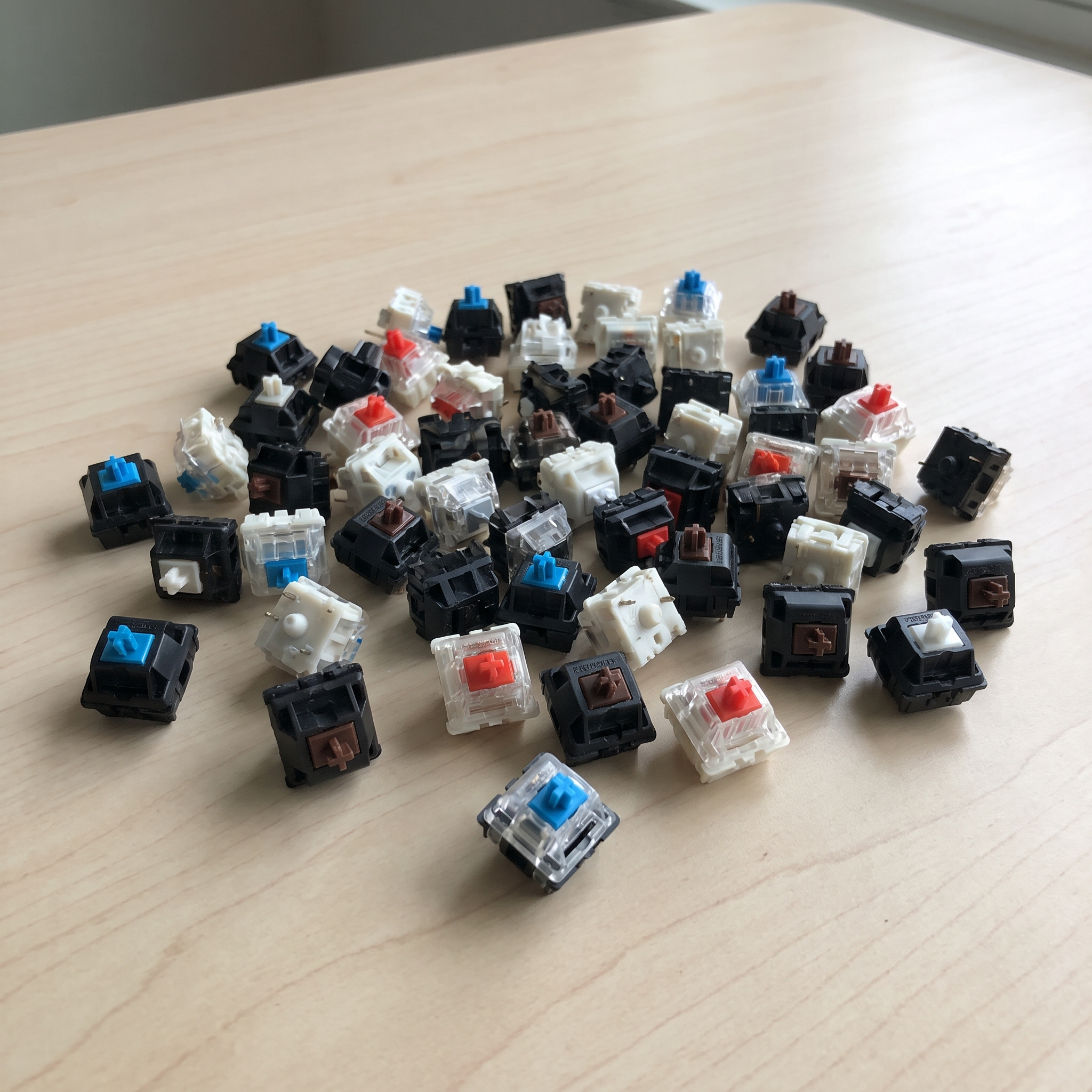
What Are Long Pole Switches and Why Is Everyone Talking About Them?
If you have spent any time watching keyboard sound tests lately, you have heard the word clacky thrown around constantly — and more often than not, the switch responsible is a long pole switch. Long pole switches have become one of the most requested switch styles in the hobby, and for good reason: they change how a keyboard sounds and feels without requiring a single mod.
A long pole stem is exactly what it sounds like. The center pole of the switch stem — the vertical column that runs down the middle of the stem and guides it as you press — is made longer than usual. That one change shortens the total travel distance and completely reshapes the bottom-out.
This guide explains what a long pole switch is, how the longer stem pole shortens travel, why long pole switches sound sharper and clackier than standard switches, and who should use them.
How a Long Pole Stem Changes Total Travel Distance
In a standard MX-style mechanical switch, the stem drops until its slider rails — the wider shoulders of the stem — meet the bottom housing. That contact is what stops the keypress. Most standard switches land at roughly 4.0mm of total travel.
On a long pole switch, the extended center pole reaches the bottom housing before the slider rails do. The pole becomes the part that stops the keystroke, and because it is longer, it stops the stem earlier in the downstroke.
The effect is significant. Adding even a millimeter of pole length can cut total travel noticeably, and long pole designs commonly land in the 3.4mm to 3.7mm range instead of the usual 4.0mm. Some aggressive designs go shorter still.
A concrete example from our own catalog makes this easy to see:
- The Gateron Oil King Switches use a conventional stem with 2mm pre-travel and 4.0mm total travel — a standard-length keystroke.
- The Gateron Luciola Linear Switches use an extended stem for a reduced total travel of 3.6±0.2mm and a noticeably quicker bottom-out.
That is roughly 0.4mm less travel on every single keypress. It sounds tiny on paper. Under your fingers, it is one of the most immediately obvious differences between two switches.
Does a Long Pole Change the Actuation Point?
This is the single most common misunderstanding about long pole switches, so it is worth being precise.
The actuation point — the depth at which the keypress actually registers — is determined by the metal leaf inside the switch and where the stem's cutout releases it. A longer center pole does not move the leaf. On most long pole switches, pre-travel stays roughly the same.
What changes is everything after actuation. The distance between the actuation point and the bottom of the keystroke gets shorter. Because the total keystroke is compressed while actuation stays put, the actuation point ends up sitting proportionally later — closer to the middle of the press rather than the top third. Many people describe this as the switch feeling "more immediate," and that perception is real, even though the registration depth itself has not moved.
If you specifically want to adjust where a key registers, a long pole mechanical switch is not the tool for that job. That is what magnetic switches and Hall effect boards are built to do.
Why Long Pole Switches Sound Clacky
The sound difference comes down to contact area.
When a standard stem bottoms out, the broad slider rails spread the impact across a relatively wide, flat area of the bottom housing. That produces a fuller, rounder, lower-pitched sound — the classic thocky profile people chase with foam and heavy cases.
When a long pole stem bottoms out, a much smaller area of plastic strikes the housing. Concentrating the same energy into a smaller contact patch produces a sound that is higher in pitch, sharper in attack, and shorter in decay. That is the clack.
Our product description for the Gateron Smoothie Linear Switches puts it well — the long-pole bottom-out stem works by concentrating the bottoming sound rather than spreading it out.
Housing Material Matters More on Long Pole Switches
Because the pole strikes a focused point, the acoustic character of the bottom housing material gets amplified rather than muted:
- POM housings tend to produce a deeper, rounder clack with a slightly muted edge. The Gateron Smoothie is built from full POM.
- Polycarbonate and transparent PC housings are thinner-sounding and brighter, and a long pole makes that brightness far more obvious.
- Nylon PA66 housings sit deeper and darker, softening the sharpness a little.
This is why two long pole switches with identical travel can sound completely different. If you are shopping for a specific sound, the housing material and the pole length have to be considered together.
How Long Pole Switches Feel Compared to Standard Switches
Sound is the headline, but the typing feel is what people either love or bounce off.
A long pole bottom-out is firm, abrupt, and precise. There is very little cushion at the end of the stroke — the stem simply stops. Compared to a standard switch, which lands with a broader, softer thud, a long pole feels like hitting a hard floor rather than a padded one.
What people like about it:
- A crisp, decisive end to every keystroke with no mushiness
- Less wasted travel, which can feel faster during gaming
- Excellent typing rhythm feedback — you always know exactly where the bottom is
What people dislike about it:
- It can feel harsh on the fingertips during long typing sessions, especially for heavy bottom-out typists
- The sharper sound is louder in a shared room or office
- Paired with a stiff plate and no foam, it can cross from crisp into rattly
If you type gently and float above the bottom-out, a long pole switch is easy to live with. If you slam your keys, consider trying one before buying a full set. A switch keychain tester is the cheapest way to feel a bottom-out before committing to 70 or more switches.
Long Pole vs Standard Pole: Which Should You Choose?
There is no universally better answer, but the decision usually breaks down cleanly.
Choose a long pole switch if you want:
- A bright, clacky, sharp sound signature
- Shorter total travel and a fast, decisive bottom-out
- A build where the switch does the acoustic work instead of heavy modding
- Gaming keystrokes that stop quickly
Choose a standard pole switch if you want:
- A deeper, fuller, thockier sound
- A softer, more forgiving landing for long typing sessions
- The full 4.0mm keystroke you are already used to
- A quieter board overall
You can browse both styles across our linear switches, tactile switches, and full key switches collections. Long pole designs are most common in linears, where the uninterrupted downstroke makes the sharp bottom-out stand out most clearly.
Building Around a Long Pole Switch
Long pole switches respond strongly to the rest of the build, so a few choices matter more than usual.
- Keycap material and thickness: thick PBT keycaps deepen and round off a clacky bottom-out, while thin ABS lets more of the sharpness through. Browse options in our keycaps collection.
- Plate choice: a stiffer plate exaggerates the clack, while a softer plate like polycarbonate or a gasket-mounted build absorbs some of the harshness.
- Foam: case and plate foam will not remove the clack — the sound originates at the stem-to-housing contact — but foam does clean up hollowness and case echo around it.
- Stabilizers: because long pole switches are sharper and more articulate, poorly tuned stabilizers stand out badly. Tune them before blaming the switches.
If you are swapping switches to audition different sounds, a hot-swap board plus a decent puller from our keyboard tools collection makes the process painless, and a case from our switches storage collection keeps your spare sets organized between builds.
Common Myths About Long Pole Switches
"Long pole switches are faster." They shorten total travel, not actuation depth. Any speed benefit comes from the keystroke ending sooner and returning sooner, not from registering earlier.
"You can just swap a long pole stem into any housing." This one trips up a lot of people. Frankenswitching a long pole stem into a different bottom housing may not reduce travel at all, because pole length only produces its intended effect in a housing designed around it. Housing depths vary between manufacturers.
"Long pole means low quality." Pole length is a deliberate design choice targeting a specific sound, not a shortcut. Plenty of premium switches use long poles.
"Foam will fix the harshness." Foam changes case resonance, not the bottom-out impact itself. If a long pole switch feels too harsh, the fix is a softer plate, thicker keycaps, or a lighter typing style.
Frequently Asked Questions About Long Pole Switches
What is a long pole switch in simple terms?
It is a mechanical switch whose stem has an extended center pole, so the pole hits the bottom housing before the stem's slider rails do. This shortens the total travel distance and produces a sharper, clackier bottom-out than a standard switch.
How much shorter is the travel on a long pole switch?
Standard MX-style switches are typically around 4.0mm of total travel. Long pole switches commonly land between roughly 3.4mm and 3.7mm. For example, the Gateron Luciola is specified at 3.6±0.2mm, compared with the 4.0mm of the standard-travel Gateron Oil King.
Are long pole switches louder than normal switches?
Usually yes, or at least they are perceived as louder. The sound energy is concentrated into a smaller contact area, which raises the pitch and sharpens the attack. Higher-pitched, sharper sounds carry more in a room even at similar volume, so long pole switches are generally a poor fit for a quiet shared office. Silent switches are the better choice there.
Are long pole switches good for gaming?
Many gamers like them. The shorter travel means the keystroke ends and resets sooner, and the firm bottom-out gives clear physical feedback. That said, the actuation point is unchanged, so a long pole switch does not register your input any earlier than a standard switch with the same pre-travel.
Can I make a normal switch into a long pole switch?
Not reliably. Swapping a long pole stem into a different switch's bottom housing often fails to shorten travel, since housing depth and pole length are designed as a matched pair. Buying a switch built as a long pole design is far more predictable than trying to create one.
Do long pole switches wear out faster?
There is no evidence that pole length meaningfully reduces switch lifespan. Rated lifespans on quality switches are extremely high regardless of pole design — the Gateron Oil King, for instance, is rated for up to 60 million cycles.
Final Thoughts: Is a Long Pole Switch Right for You?
Long pole switches are the most direct way to get a bright, clacky, crisp sound out of a keyboard without modding anything. The extended stem pole shortens total travel, concentrates the bottom-out into a smaller contact area, and delivers a firm, decisive end to every keystroke.
They are not for everyone. Heavy typists and anyone sharing a room may prefer the softer landing and deeper tone of a standard-travel switch. But if you have been chasing that sharp, articulate sound you keep hearing in sound tests, the switch stem — not the foam, the case, or the keycaps — is almost always where it starts.
Ready to hear the difference for yourself? Explore our full range of Gateron linear switches and the wider key switches collection to find a sound signature that fits your build.


