

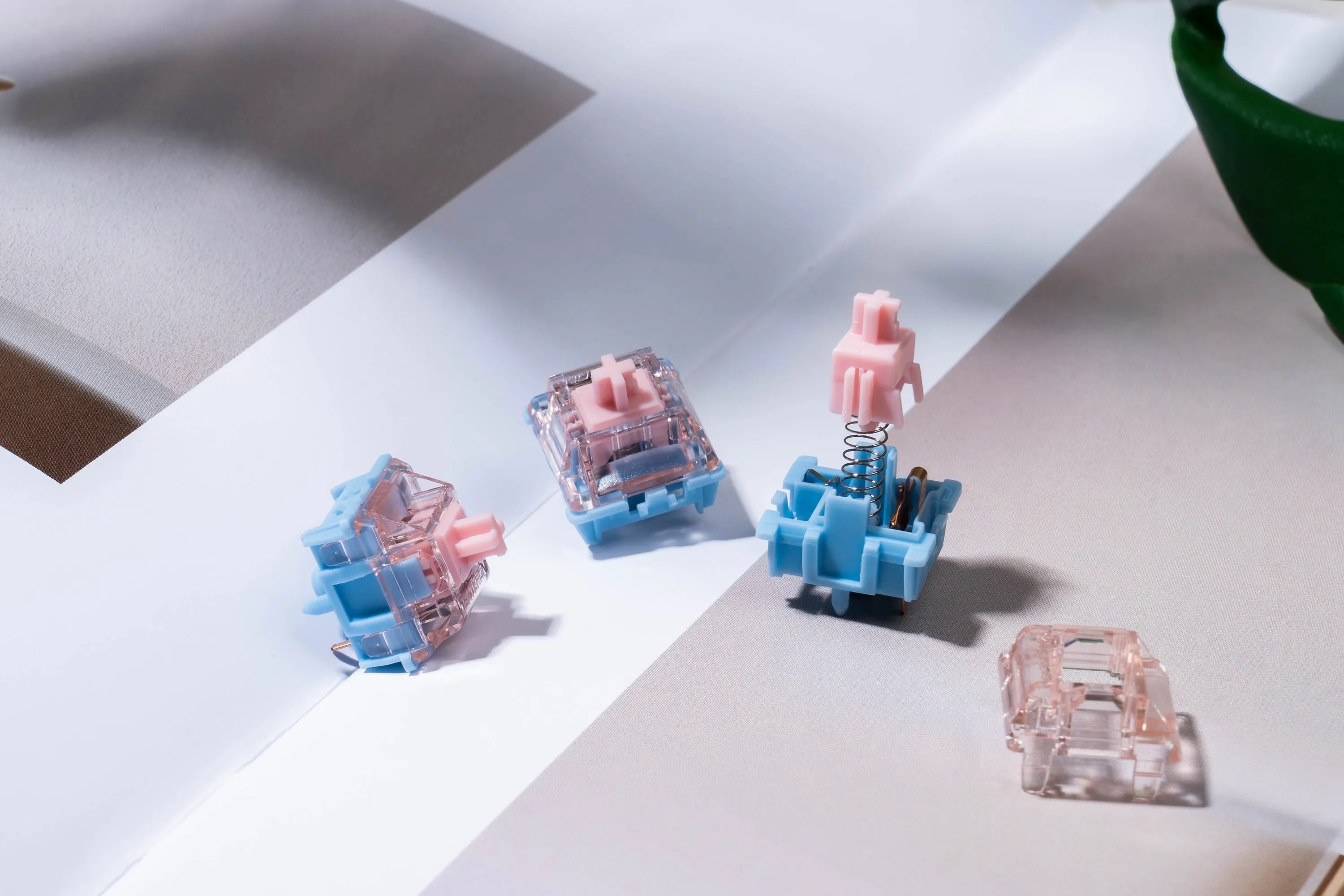
Are Pre-Lubed Switches Good Enough, or Should You Hand Lube?
Pre-lubed switches have quietly become the default. A decade ago a smooth linear meant an afternoon with a brush, a tub of grease and a pile of switch housings on a desk. Today most enthusiast switches arrive factory lubed from the manufacturer, and the question has flipped. Instead of "how do I lube my switches?", people now ask "are pre-lubed switches good enough, or do I still need to hand lube them?"
The honest answer depends on which switch you bought and what you are trying to fix. This guide covers what factory lube actually does, where hand lubing switches still makes a measurable difference, which switch types you should leave alone entirely, and how to decide whether the hours are worth it for your build.
What Does Pre-Lubed Actually Mean?
A mechanical switch has several surfaces that rub together every time you press a key. The stem rails slide against the housing, the spring compresses and scrapes against the stem and base, and on tactile switches the stem legs drag across a bump inside the housing. Friction at those points is what people hear as scratchiness, and it is what lubricant reduces.
When a switch is described as pre-lubed or factory lubed, the manufacturer has applied lubricant to some of those surfaces during assembly rather than leaving the switch dry. The important detail is the phrase some of those surfaces. Factory application is fast and mechanised, which brings two consequences worth understanding:
- The amount is consistent. Machine application puts a similar quantity on every unit, which is difficult to match by hand across a hundred switches.
- The coverage is partial. Factories typically target the highest-friction areas rather than every contact point, and springs are often lubed lightly or not at all.
Quality varies enormously between manufacturers. A factory-lubed switch from a major producer can beat a rushed hand-lube job, while a cheap switch labelled "pre-lubed" may have barely enough lubricant to matter. The label alone tells you little — the manufacturer behind it tells you a lot.
Factory Lubed vs Hand Lubed Switches: The Real Differences
Set the forum arguments aside and the differences come down to four things.
Control. The genuine advantage of hand lubing. You choose the lubricant, the quantity and exactly which surfaces receive it. With factory lubed switches you take what you are given.
Consistency. Here the popular assumption is often backwards. Hand lubing is repetitive, and a beginner's hundredth switch rarely matches their first. Machine application does not get tired, so factory switches are frequently more uniform key to key than an amateur hand-lube job.
Springs. This is where hand work most reliably wins. Spring ping — that faint metallic ring after a keypress — comes from the spring vibrating, and factory processes often skip springs entirely. Read our guide to what causes keyboard ping first, though, because plenty of ping originates in the case rather than the switches.
Time. Hand lubing a full-size board means opening, brushing and reassembling well over a hundred switches one at a time — realistically several hours across an evening or two. That cost is the entire debate.
When Hand Lubing Switches Is Still Worth It
There are clear cases where reaching for a brush genuinely pays off:
- Your switches are completely dry. Budget and older designs often ship with no lubricant at all, and the improvement from lubing a dry linear is dramatic rather than subtle.
- You can hear spring ping. The single most reliable fix hand lubing offers.
- Coverage feels uneven. If a handful of keys are noticeably scratchier than the rest, topping those up evens things out.
- You are chasing a specific sound. Lube is one lever builders use to move a board toward a deeper, muted signature — our guide to getting a thocky keyboard sound covers where it sits among the others.
- You enjoy the process. For plenty of people the build is the hobby, not an obstacle to it.
When You Should Leave Your Switches Alone
Equally, there are cases where lubing switches makes things worse.
Clicky switches. The click comes from a dedicated mechanism — a click jacket or click bar — deliberately designed to make noise. Coating it in grease dampens exactly the thing you bought the switch for. Most builders leave clicky switches untouched.
Tactile switches, mostly. The tactile bump is friction by design, so lubricant on the stem legs softens or erases it. Careful builders use a thinner lubricant on the rails only and keep it away from the legs, but a heavy hand is one of the most common ways beginners ruin a set. If you like the bump on your tactile switches, leave them as they came.
Silent switches. These rely on dampening material inside the housing to absorb the impact at the top and bottom of travel. That system is tuned as a whole, and adding grease on top of it tends to produce a mushy feel rather than a quieter one. Switches like the Glacier Skyloong Silent Switches are meant to be used as supplied.
Magnetic and Hall effect switches. These measure a magnet's position rather than closing a physical contact, and are generally sold ready to use — the Gateron Magnetic Jade Linear Switches arrive pre-lubed, for instance. Since disassembly risks disturbing the magnet and the tolerances these switches depend on, the sensible default across the magnetic switches category is to leave them factory-fresh.
Which Lubricants Are Used, and Why Viscosity Matters
Lubricants are sold under a wall of product codes, but one property explains most of the choices: viscosity. Thicker greases smooth more aggressively and dampen more sound. Thinner oils and greases reduce friction while preserving more of the switch's original character.
- Linear switches tolerate the thickest lubricants, because there is no tactile bump to protect. A heavier grease on the stem rails and housing is the standard approach.
- Tactile switches call for a noticeably thinner grease on the rails only — enough to reduce scratch without flattening the bump. Linear-grade greases are the wrong tool here.
- Springs take a thin oil rather than a grease. Oil coats the coils and damps the vibration that causes ping; heavy grease just weighs the spring down.
The other variable is where it goes. Rails and housing walls are safe on any switch type. The stem legs on a tactile and the click mechanism on a clicky are the two places to avoid — both generate the feedback you chose that switch for.
More is not better. Over-lubing is the most common beginner mistake and it is not easily reversible. Too much lubricant makes keys feel sluggish, mutes tactility, and can interfere with the contact leaf inside the switch. It also masks the material character you paid for — a POM or nylon housing chosen for its sound signature disappears under a heavy coat of grease. A thin, even film beats a generous one every time.
How Pre-Lubed Switches Fit Into a Hot-Swap Build
If your keyboard is hot-swappable, both paths stay open, which takes the pressure off the decision. Start with quality pre-lubed switches, live with the board for a few weeks, and revisit lubing only if something specific bothers you.
That has a practical advantage: you learn what you actually dislike before committing hours to fixing it. Scratchiness, ping, a hollow case and rattling stabilizers are four different problems, and lube only addresses two of them. Plenty of people hand lube a full set and find the noise they were chasing came from the stabilizers all along.
Either way you will need a proper switch puller to remove switches without bending pins: grip the latches on the top and bottom edges, pull straight up rather than at an angle, and check the pins before reinstalling. The Glacier Keycap/Switch Puller Tool and the two-in-one Glacier Keycap/Key Switch Tool both handle keycap and switch removal, and the wider keyboard tools range covers the rest. Our guide to replacing switches safely walks through the technique in detail.
How to Choose Pre-Lubed Switches Worth Keeping
If you would rather skip lubing altogether, the trick is buying switches where the factory did the job properly.
- Look for manufacturers with a track record. Factory lube quality is a manufacturing discipline, and the established producers are far more consistent than unbranded alternatives. The Gateron and Kailh ranges are reliable starting points.
- Check whether pre-lubing is a stated feature. The Gateron G Pro 3.0 Switches carry the factory pre-lubed treatment forward from the G Pro 2.0 as an explicit design point, and the Kailh Box Spring Linear Switches pair a lubricated stem with a high-slip POM base — housing material doing part of the smoothness work that lubricant would otherwise have to do alone.
- Try before you commit to a hundred. A small quantity first is far cheaper than lubing a set you turn out to dislike, and our guide to testing switches before buying covers the faster route.
- Match the switch type to the job. No amount of lubricant turns a switch into something it is not. Start from the sound profile you want and pick from linear, tactile, clicky or silent accordingly.
Frequently Asked Questions About Pre-Lubed Switches
Are pre-lubed switches good enough for most people?
For most people, yes. A quality factory-lubed switch is smooth enough out of the bag that the difference from hand lubing is small and gets smaller once the switches are installed in a case with keycaps on. Hand lubing is worth the hours if your switches are dry, if you can hear spring ping, or if you are tuning a build toward a specific sound.
Do I need to lube switches that are already pre-lubed?
Not usually. Adding lubricant on top of an existing factory coat is how switches end up over-lubed and sluggish. If a pre-lubed set feels uneven, the better approach is to open a few of the worst keys and even them out rather than re-lubing everything.
Does lubing switches make them quieter?
It changes the sound more than the volume. Lubricant removes high-frequency scratch and spring ping, which makes a board sound deeper and cleaner rather than significantly quieter. If actual noise reduction is the goal, silent switches with built-in dampening are far more effective — our comparison of clicky versus silent switches covers the trade-offs.
Can you over-lube a mechanical switch?
Yes, and it is the most common mistake beginners make. Excess lubricant makes keypresses feel slow and mushy, dulls or removes tactility, and in bad cases can affect how reliably the switch registers. A thin, even film is the target — you should not be able to see pooled lubricant inside the housing.
Should you lube tactile or clicky switches?
Clicky switches are best left alone, since lubricant dampens the click mechanism they are built around. Tactile switches can be lubed, but only lightly and with a thinner lubricant, kept off the stem legs where the bump is generated. If you like your tactiles as they are, factory-fresh is the low-risk choice.
The Practical Verdict on Factory vs Hand Lubed Switches
The gap between pre-lubed switches and a careful hand-lube job has narrowed to the point where, for most builds, factory lube is good enough. Manufacturing has improved, housing materials do more of the work than they used to, and the marginal gain from an evening of brushwork is smaller than the community's enthusiasm suggests.
Hand lubing still earns its place — on dry switches, on ringing springs, and on builds where you are deliberately shaping a sound. What it is not is mandatory. Buy switches from a manufacturer that lubes properly, install them, and give the board a couple of weeks. If something still bothers you, you will know exactly what to fix, and you will not have spent five hours fixing the wrong thing.
Browsing options? The full key switches collection lists type, pin count and quantity for each set, and the keyboard accessories range covers the pullers, storage and tools you will want alongside them.


