

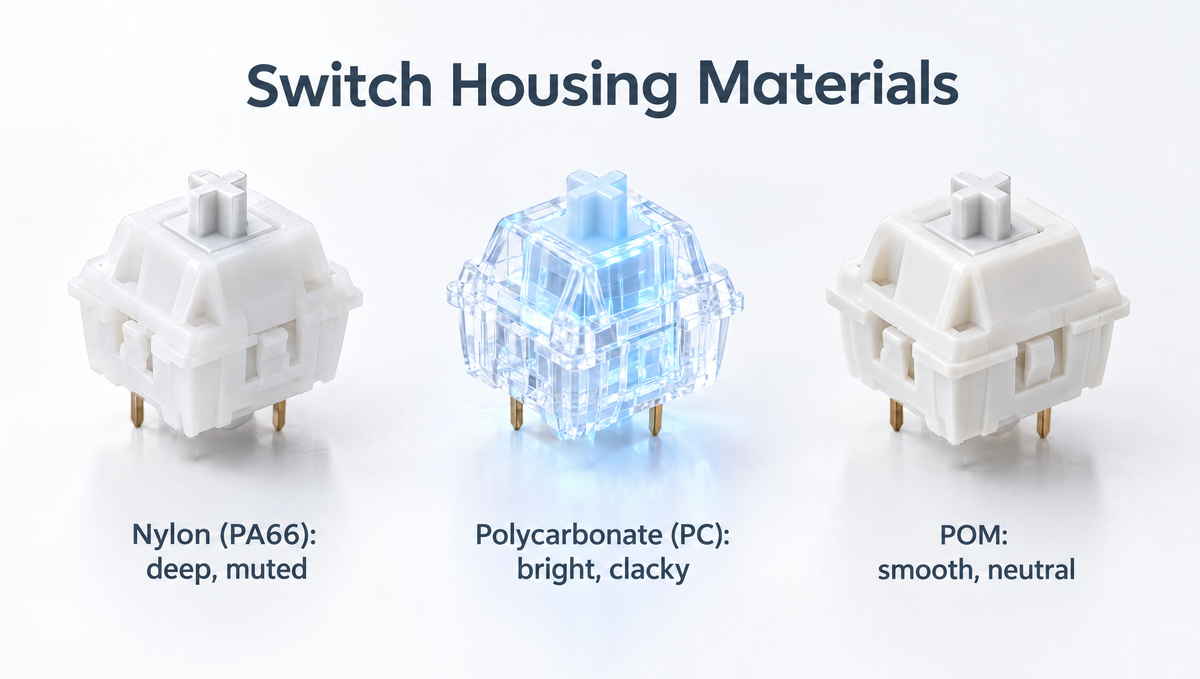
Switch Housing Materials Explained: Why Plastic Decides Your Sound
Two switches can share the same spring weight, the same travel distance and the same tactile bump, and still sound like completely different keyboards. The reason is almost always the plastic. Switch housing materials — the nylon, polycarbonate, POM and UHMWPE used for the top housing, bottom housing and stem — shape the pitch, depth and texture of every keystroke before the case or the keycaps get a say.
This is the part of switch shopping that gets skipped. People compare actuation force charts and ignore the material line in the spec sheet, then wonder why their "thocky" switch came out sounding sharp and hollow. If you have ever asked what makes a switch sound thocky, or why nylon switches sound deeper than clear ones, the answer starts here.
This guide breaks down each switch housing material, explains what the top housing, bottom housing and stem each contribute to the sound, and shows how to read a switch spec sheet so you can predict the sound signature before you buy.
What a Switch Housing Actually Is
A modern MX-style mechanical switch is built from three plastic parts plus a spring and a metal leaf:
- Top housing — the upper shell the stem passes through. It takes the impact when the key returns to rest, so it drives the top-out sound.
- Bottom housing — the base that holds the leaf, the spring and the pins. The stem crashes into it at the end of the keypress, so it drives the bottom-out sound, which is the loudest part of a keystroke for most typists.
- Stem — the moving cross-shaped piece your keycap sits on. It rubs against the housing rails on every press, so it mostly governs smoothness and scratchiness, with a secondary effect on tone.
Manufacturers mix and match. It is completely normal for a single switch to use three different plastics — and that mixing is exactly how switch designers tune a sound signature.
Nylon (PA66): The Deep, Thocky Standard
Nylon, usually listed on spec sheets as PA66 or polyamide 66, is the classic housing plastic and the one most associated with a deep, rounded thock.
- Sound — lower-pitched and more muted. Nylon flexes and damps impact energy rather than ringing, which softens the bottom-out into a fuller, less sharp sound.
- Appearance — opaque or milky. Nylon does not transmit light well, so nylon housings mute RGB rather than showcase it.
- Feel — slightly softer landings than harder plastics.
- Variation — nylon is not one thing. Different suppliers and different blends produce noticeably different results, so two "nylon housing" switches will not sound identical.
Nylon is the material to look for if your goal is a deeper keyboard sound. The Gateron Oil King Switches are a good example of the approach: a nylon PA66 top housing paired with Gateron's proprietary Ink base and a POM stem, producing a deep, low-pitched signature. The Gateron Baby Kangaroo 2.0 Switches use a similar idea from the tactile side — a nylon PA66 milky base under a transparent cover and a POM stem.
Polycarbonate (PC): Bright, Clacky and RGB-Friendly
Polycarbonate sits at the other end of the spectrum. It is a stiffer, harder, optically clear plastic, and it is the reason so many modern switches sound crisp and bright.
- Sound — higher-pitched and clearer, with a sharper, more defined clack. PC rings rather than damps, so impacts come through with more attack.
- Appearance — transparent or translucent. This is why nearly every switch built around RGB lighting uses PC somewhere.
- Feel — firmer, more defined bottom-out with less give.
- Common use — very often used for the top housing specifically, where it both brightens the top-out and lets light through.
If you want illumination to actually show, PC is effectively mandatory. The Gateron Upgraded North Pole 2.0 Switches go all-in on this with a highly transparent PC cover and base plus a light guide pole, which is the combination you want for a bright, even RGB effect.
POM: The Stem Material That Does the Real Work
POM — polyoxymethylene, also sold as acetal or Delrin — is the default stem plastic across the industry, and for good reason.
- Low friction — POM is naturally slick against housing rails, which is why POM-stemmed switches feel smooth even with modest factory lubrication.
- Dimensional stability — it holds its shape under repeated stress, which keeps stem wobble and long-term wear in check.
- Sound — denser and harder than nylon, giving a fuller, slightly brighter note than nylon but without polycarbonate's sharpness. Most people describe it as neutral to marbly.
- Full-POM builds — when a switch uses POM for housings as well as the stem, the result is typically smooth and full-bodied rather than sharp.
The Gateron Smoothie Linear Switches are a full POM switch built around exactly that logic, with a long-pole stem that concentrates the bottom-out. On the Kailh side, the Kailh Box Spring Linear Switches use a high-slip POM base for the same smoothness goal, wrapped in Kailh's dustproof Box stem design. You will also find POM stems in switches with completely different housings, like the Gateron Luciola Linear Switches, which pair a POM stem with an Ink bottom housing.
UHMWPE and the Ultra-Smooth Tier
UHMWPE — ultra-high-molecular-weight polyethylene — is the enthusiast darling and the softest of the common switch plastics.
- Self-lubricating — it has an extremely low coefficient of friction, so UHMWPE parts glide without added lube. This is the headline property.
- Sound — softer and more muted than POM, with a rounder, poppier character. It absorbs impact rather than transmitting it.
- Trade-off — it is a softer plastic, so it can be less dimensionally rigid than POM over heavy use and repeated keycap swaps.
- Availability — it is a premium, lower-volume material, and it appears in far fewer switches than nylon, PC or POM.
You will also see derivative blends marketed under names like POK and LY, which aim to combine UHMWPE's slickness with more rigidity. Treat those names as marketing until you hear a sound test — the underlying claim is usually "smoother than POM, more stable than pure UHMWPE."
How to Read a Switch Spec Sheet and Predict the Sound
Once you know the materials, a spec sheet becomes genuinely predictive. Work through it in this order:
- Find the bottom housing first. It has the biggest influence on the sound you will actually hear, because bottom-out is the dominant event. Nylon bottom housing means deeper. PC bottom housing means brighter.
- Then check the top housing. This shapes the return sound and the overall brightness. A PC top over a nylon bottom is an extremely common "best of both" pairing — clear and defined without being harsh.
- Then the stem. POM for smoothness and a neutral note, UHMWPE for maximum glide and a softer landing.
- Check for a long pole. A long-pole stem shortens total travel and sharpens the bottom-out into a more concentrated, clackier sound regardless of housing plastic.
- Check the spring length. Longer and dual-stage springs change the force curve and the ping character, which layers on top of everything above.
A practical shortcut: opaque usually means deeper, transparent usually means brighter. It is not a law, but it holds often enough to be useful when you are scanning a listing.
Housing Material Is Only Part of the Equation
It is worth being honest about scale here. Switch housing material is a real variable, but it is not the only one, and it is not always the biggest.
- The keyboard itself — case material, mounting style, plate choice and foam collectively do more to your sound than the switch plastic does.
- Keycaps — thick PBT and thin ABS produce genuinely different results on identical switches.
- Lubrication — lube changes both smoothness and pitch, and can narrow the gap between two different housing materials considerably.
- Stabilizers — rattle on the larger keys will overshadow any subtle housing difference.
So treat housing material as a tuning lever, not a magic switch. If your board sounds hollow and pingy, the fix is more likely foam and stabilizer work than swapping nylon for POM. If your board already sounds good and you want to shift the pitch, then housing material is exactly the right lever.
Choosing Switch Housing Material by Goal
- You want deep and thocky — look for a nylon PA66 bottom housing, ideally with a thicker keycap set.
- You want bright and clacky — look for polycarbonate housings and a long-pole stem.
- You want maximum smoothness — prioritise the stem: POM at minimum, UHMWPE if you can find it and afford it.
- You want RGB to look good — you need transparent PC in the top housing, and ideally a light guide pole.
- You want quiet above all — housing material alone will not get you there. Dedicated silent switches, which use internal dampening to soften both bottom-out and top-out, are the correct tool.
The most reliable way to settle it is to feel and hear the options yourself before committing to a full set. A switch keychain tester lets you compare individual switches directly, and the wider keyboard tools range covers the pullers you will need to swap them safely on a hot-swap board.
Frequently Asked Questions
What switch housing material is the thockiest?
Nylon, usually listed as PA66, is the material most associated with a deep, thocky sound. It flexes and damps impact energy instead of ringing, which lowers the pitch of the bottom-out. For the deepest result, look for a nylon bottom housing specifically, and pair it with thick keycaps and a well-damped case.
Does the top housing or the bottom housing matter more for sound?
The bottom housing generally matters more, because bottom-out is the loudest and most frequent impact in a keystroke. The top housing shapes the quieter top-out and return sound. A polycarbonate top over a nylon bottom is a very common pairing precisely because it adds clarity without giving up depth.
Why do transparent switches sound sharper than opaque ones?
Transparent switch housings are usually polycarbonate, which is a harder, stiffer plastic than nylon. Stiffer materials transmit impact energy more readily rather than absorbing it, which produces a higher-pitched, more defined clack. Opaque housings are more often nylon, which damps that energy and sounds deeper.
Is UHMWPE better than POM for switch stems?
UHMWPE is smoother and softer, with a rounder sound and self-lubricating behaviour. POM is harder, more dimensionally stable and far more widely available. Neither is universally better — UHMWPE wins on glide and muted sound, POM wins on rigidity, consistency and value. POM remains the industry standard for good practical reasons.
Can I change my keyboard's sound without replacing the switches?
Yes, and it is often the cheaper route. Lubing your existing switches, tuning the stabilizers, adding case or plate foam, and changing keycap material and thickness will all move your sound significantly. Work through those first — if the pitch is still not where you want it after that, then housing material is the right next step.
The Bottom Line
Switch housing materials are the most overlooked line on a spec sheet and one of the most predictive. Nylon PA66 damps and deepens. Polycarbonate stiffens, brightens and lets light through. POM delivers the low-friction smoothness that makes a stem feel good. UHMWPE takes that smoothness further at the cost of rigidity and availability.
Read the bottom housing first, the top housing second and the stem third, factor in whether the stem is long-pole, and you can predict a switch's sound signature with reasonable accuracy before it ever reaches your desk. Browse the full key switches range, or narrow by brand with Gateron switches and Kailh switches, and check the material line before you check anything else.


