

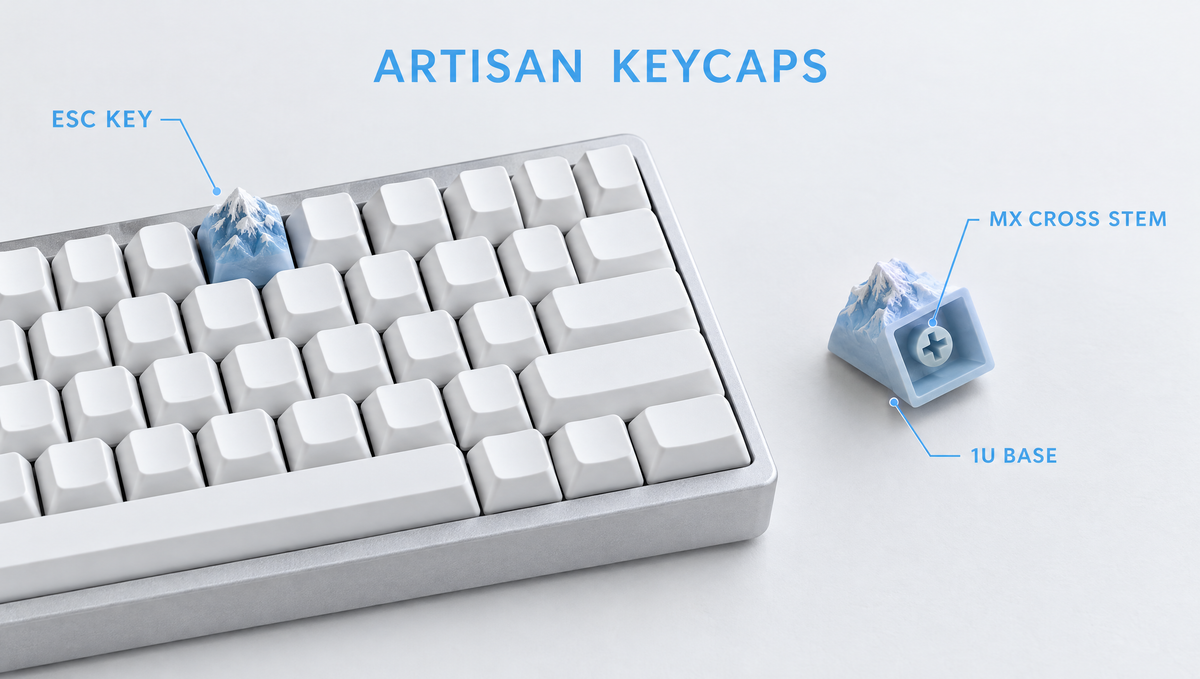
Artisan Keycaps Explained: What They Are and Why People Love Them
Artisan keycaps are the small sculptures of the mechanical keyboard world. Instead of a flat cap with a printed letter, an artisan keycap might be a tiny mountain, an animal, a landscape sealed in clear resin or a machined block of metal, all sitting on a normal switch. If you have ever seen a keyboard photo where one key looks completely different from the rest and wondered "what is that keycap?", you were almost certainly looking at an artisan.
This guide explains what artisan keycaps are, the main materials (resin, clay, metal, wood and 3D printed artisan keycaps), how to check whether one will fit your keyboard, where to put it, how to install and remove it without damage, and whether artisan keycaps are worth it for you.
What Are Artisan Keycaps?
An artisan keycap is a decorative, individually designed keycap, usually made by a small maker or studio rather than mass-molded in a factory. Most are sold one key at a time or in small themed packs, not as full keycap sets.
What separates an artisan from a regular keycap:
- Sculpted shape: the top is a design or miniature scene rather than a smooth, finger-shaped surface
- Small production runs: many are made in limited batches, so designs and colorways come and go
- Visible handwork: small differences between units are normal and part of the appeal
- Accent use: they are meant to be one or a few standout keys, not a whole board
Artisans have been part of the enthusiast hobby for years, and they remain one of the easiest ways to make a keyboard look personal without rebuilding it. Swapping one keycap takes seconds and needs no tools beyond a keycap puller.
Artisan Keycap Materials: Resin vs Clay vs Metal vs 3D Printed
The material decides how an artisan looks, how durable it is and how much it costs. These are the main types you will see.
Resin artisan keycaps
Resin keycaps are the classic artisan. A maker sculpts a master design, makes a silicone mold from it, then casts colored two-part resin into the mold, sometimes in several layers or "shots" to build up colors and depth. Resin allows translucent effects, swirls and objects encapsulated inside the cap. Because silicone molds wear out over time, resin runs are often limited.
Clay and hand-sculpted keycaps
Polymer clay caps are sculpted by hand, cured and then painted and sealed. They can be extremely detailed, but clay is more fragile than resin, so these are usually treated as display keys rather than keys you press constantly.
Metal artisan keycaps
Metal keycaps are typically machined or cast from materials such as aluminum, brass or copper. They are very durable and feel noticeably heavier than plastic, which also changes how that key sounds and feels when pressed. Brass and copper can tarnish over time unless they are coated or polished.
Wood keycaps
Wood caps are carved or machined and are sometimes combined with resin for a hybrid look. Wood is warm and natural looking, but it does not like moisture and can chip if dropped.
3D printed artisan keycaps
3D printed keycaps are the fastest growing part of the artisan scene. Modern multi-material printers can print several colors in one piece, which means the colors are part of the plastic itself rather than paint that can rub off. Printing on demand also means a design does not have to sell out in a limited run.
The trade-offs are worth knowing: fine layer lines are usually visible up close, and common printing plastics such as PLA can soften with heat, so a 3D printed keycap should not be left in a hot car or right next to a heater. For example, the Glacier Polar Pack 3D Printed Artisan Keycaps are multi-color printed in PLA with 100% infill and come as a four-key arctic-themed pack or as single keys.
Will Artisan Keycaps Fit My Keyboard?
Artisan keycap compatibility comes down to four checks. Get these right and the key will mount and work normally.
1. Stem type
Most artisan keycaps are made for the Cherry MX-style cross stem, the plus-shaped post used by the vast majority of mechanical switches from Gateron, Kailh and many other makers. If your switches have that cross stem, an MX-compatible artisan will mount on them. Artisans made for MX stems will not fit low-profile switches, Topre or Alps switches, and some box-style switches can block a thick artisan stem with the square wall around their cross, so check the product listing if you use box switches. Our keycap compatibility guide covers stem types in more detail.
2. Key size
The vast majority of artisans are 1u keycaps, the size of a standard letter key. That means they fit Esc, function keys, arrow keys, letters and any other 1u position. Larger artisan modifiers and spacebars exist, but they are far less common, so if you want an artisan Enter or spacebar, check the size before you buy.
3. Height and clearance
Artisans are often taller than regular keycaps. That is fine on an open keyboard, but a tall sculpt can catch on a dust cover, a keyboard carry case or a monitor stand that overhangs the board. It can also sit noticeably higher than neighboring keys, which matters if you rest your hand nearby.
4. Stem fit
A good artisan grips the stem firmly without forcing it. A stem that is too tight takes excessive force to install and can stress the switch, while one that is too loose wobbles or lifts off with the keycap puller. If a new artisan needs real force to go on, stop and inspect the stem opening rather than pushing harder.
Where to Put an Artisan Keycap on Your Keyboard
The most popular spot for an artisan keycap is the Esc key. It sits in the corner where everyone sees it, it is a 1u key on almost every layout, and you press it far less than letter keys, so the sculpted top does not get in the way.
Other good homes for artisan keycaps:
- Function row keys you rarely press
- Arrow keys, where a set of four themed artisans can look great
- Navigation keys such as Home, End or Page Up
- A macro or knob-adjacent key on compact boards
Avoid putting tall or sharply sculpted artisans on keys you type on constantly, such as the home row or WASD for gaming. Artisan tops are shaped for looks, not for fingertips, so they can feel awkward under heavy use and are more likely to wear.
How to Install and Remove Artisan Keycaps Safely
Artisans are usually more delicate than standard keycaps, so a little care goes a long way.
Installing an artisan keycap
- Remove the existing keycap by pulling it straight up with a keycap puller.
- Look at the artisan's stem opening and line up the + cross with the switch stem. Check the artisan is facing the right way.
- Press down evenly on the base, not on a thin or delicate part of the sculpt, until the cap seats fully.
- Press the key a few times to confirm it travels smoothly and does not rub the neighboring keys.
Removing an artisan keycap
A wire keycap puller is the safest option for artisans because the wires hook under the bottom edge of the base and lift evenly from both sides. Never pry an artisan from one edge with a screwdriver or fingernail, and never pull on a thin part of the sculpt, which can snap off. If you are new to pullers, our guide on how to use a keycap puller and switch puller without damage walks through the technique. If you also swap switches, the Glacier Keycap/Switch Puller Tool combines a keycap puller and a switch puller in one tool.
A note for magnetic and Hall effect keyboards
Most magnetic keyboards use MX-style stems, so artisans mount normally. Because these boards measure key travel, a noticeably heavier keycap, such as a metal artisan, can change how that key behaves at very short actuation settings. If a key feels different after swapping in an artisan, re-run your keyboard software's calibration.
How to Care for Artisan Keycaps
- Dust with a soft brush rather than wiping hard over painted or detailed areas
- Clean resin, clay and plastic caps with a damp cloth and mild soap if needed, and avoid long soaks
- Keep plastic and 3D printed caps away from high heat, including hot cars, heaters and direct sun through a window
- Wipe metal caps with a lint-free cloth to slow tarnishing
- Dry completely before putting a cap back on the keyboard
- Store spare artisans separately so sculpted details do not rub against each other
Are Artisan Keycaps Worth It?
Artisan keycaps are worth it if you want your keyboard to look like yours. One accent key changes the whole look of a board for far less effort than a new keycap set, and it moves with you from keyboard to keyboard.
Prices vary widely. Hand-cast resin and machined metal artisans from small makers can cost more per key than an entire budget keycap set, especially for limited designs on the secondhand market. 3D printed artisan keycaps have made the look more accessible because they can be printed on demand instead of released in tiny batches.
They are probably not for you if you want every key optimized for typing feel, or if your keyboard lives in a bag every day where a tall sculpt could get knocked around.
Frequently Asked Questions About Artisan Keycaps
Do artisan keycaps fit any mechanical keyboard?
Most artisan keycaps fit any keyboard with MX-style cross stem switches, which covers the majority of mechanical keyboards. They do not fit low-profile switches or non-MX stems such as Topre or Alps, so check your switch stem before you buy.
Can you type on artisan keycaps?
Yes, an artisan works like any other key. However, the sculpted top is designed for looks, so most people put artisans on keys they press less often, like Esc, function keys or arrows, rather than on letters they type all day.
Are 3D printed keycaps durable?
A well-made 3D printed keycap is durable for everyday use, especially when it is printed solid. When the colors are printed in rather than painted on, they will not peel. The main precaution is heat, since plastics like PLA can soften if left somewhere very hot.
Why is Esc the most popular key for an artisan?
Esc is a 1u key on almost every layout, it sits in a visible corner, and it is pressed less often than letter keys. That makes it the easiest and safest place to show off an artisan keycap.
What is the best way to remove an artisan keycap?
Use a wire keycap puller hooked under the base on two opposite sides and lift straight up. Avoid prying from one edge or pulling on thin parts of the sculpt.
Finding the Right Artisan Keycap for Your Setup
Choosing an artisan keycap is simple once you know what to check: an MX-style stem, the right key size (usually 1u), enough height clearance and a snug stem fit. Put it on Esc or another low-traffic key, install and remove it with a proper puller, and keep it away from heat. You can browse the 3D printed keycaps collection for artisan accents, explore the full keycaps collection for a base set to pair them with, and find pullers in keyboard tools.


